
The Ultimate 10-day Kyushu Road Trip Itinerary
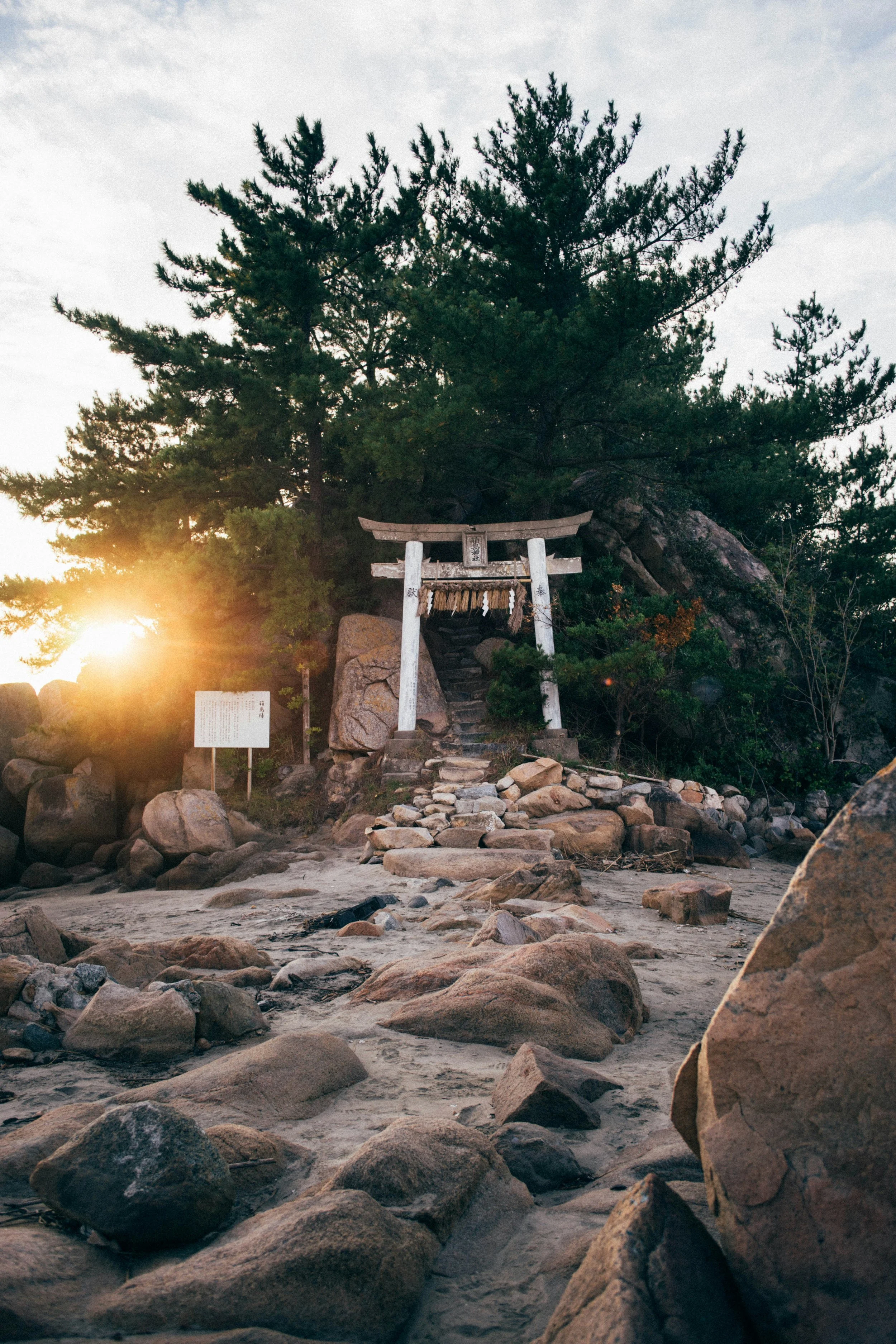
No shade to Japan’s major cities, but my most memorable experiences in this country always seem to happen in the more out-of-the-way places. Ancient forests, mountain shrines, volcanic landscapes, charming towns with Edo-era architecture and traditional bath houses that seem like they’re straight out of a Studio Ghibli movie — this is the side of Japan that true Japanophiles seek.
Kyushu never gets the attention that Tokyo, Kyoto, and Osaka do, but for those in the know, this can easily be one of the most rewarding places in the country to explore. Japan's third-largest island is where you go when you've already done the so-called “golden route” and you're ready for something with more texture and room to breathe. I’m talking volcanic calderas, hidden onsen villages, a mythological gorge, and a coastline that changes character every hour or two of driving. It's also, incidentally, one of the best road trip destinations in the entire country, the kind of place that begs to be explored by car. The expressways are excellent, the mountain roads are genuinely fun to drive, and unlike Honshu's big cities, a car here is an asset rather than a liability.
The Route
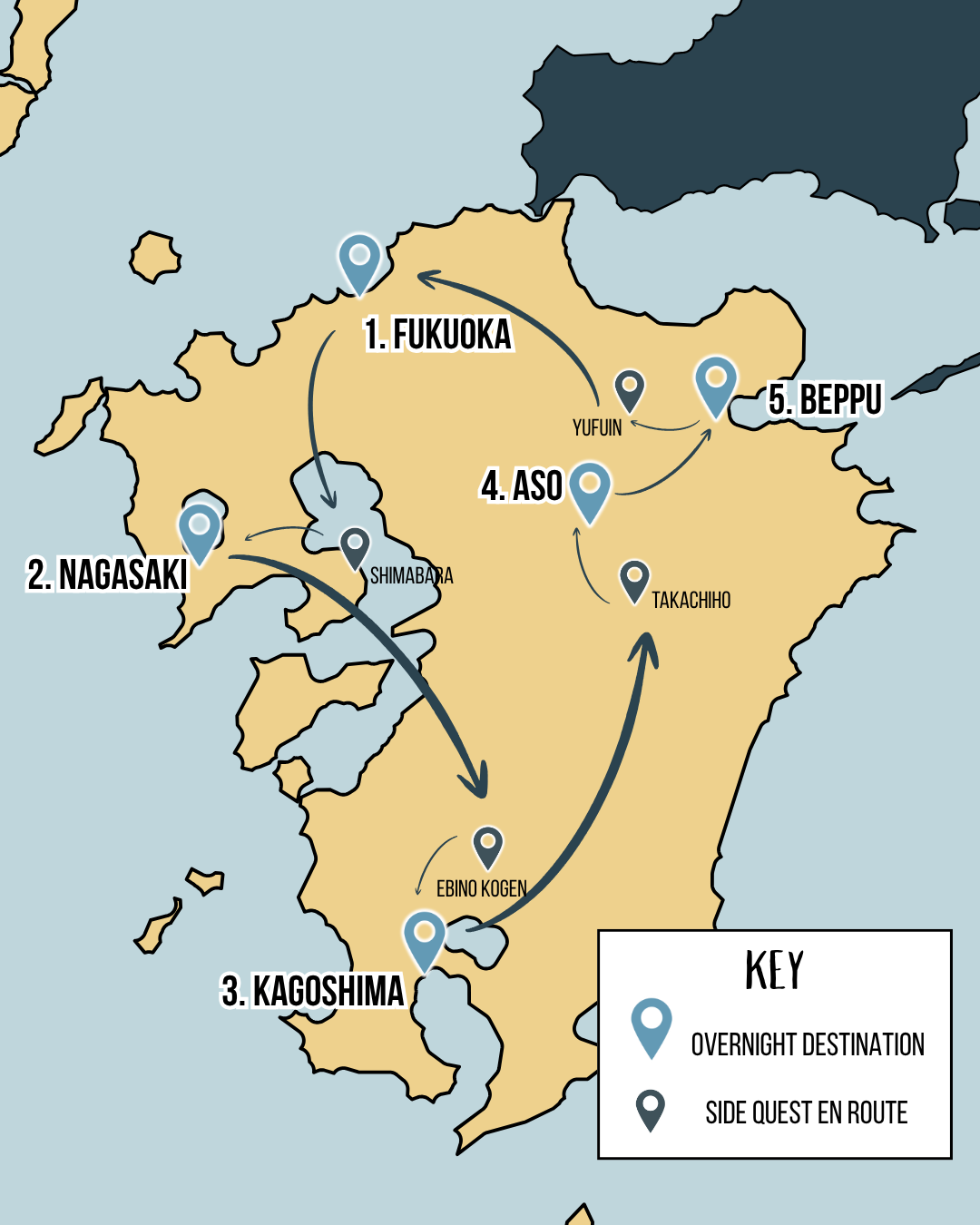
This itinerary traces a loop through five of Kyushu's major destinations — Fukuoka, Nagasaki, Kagoshima, Aso, and Beppu — with a handful of worthwhile detours (a.k.a. “side quests”) stitched in along the way.
The loop runs counterclockwise, starting and ending in Fukuoka:
Fukuoka → Nagasaki (via Shimabara) → Kagoshima (via Ebino Kogen) → Aso (via Takachiho) → Beppu (via Kurokawa Onsen) → Fukuoka (via Yufuin)
Five overnight bases, four side quests along the driving days, and one big circle back to where you started. If you're working with limited time or want to go deeper, I've included some variations at the end of this post.
Ten days. Roughly 1,170 km of driving. Let’s see how it breaks down.
Day 1: Fukuoka
Fukuoka is your gateway to Kyushu and a genuinely great city in its own right — easily underrated by travelers using it purely as a landing point before heading elsewhere. Spend your first day here before picking up your rental car.
Hakata, Fukuoka's historic commercial district, is a good place to start. It’s the birthplace of tonkotsu ramen — the rich, cloudy pork-bone broth that's become one of Japan's most recognizable exports. Any of the counter-service ramen shops in the area will do; this isn't a city where you need to hunt for a specific place.
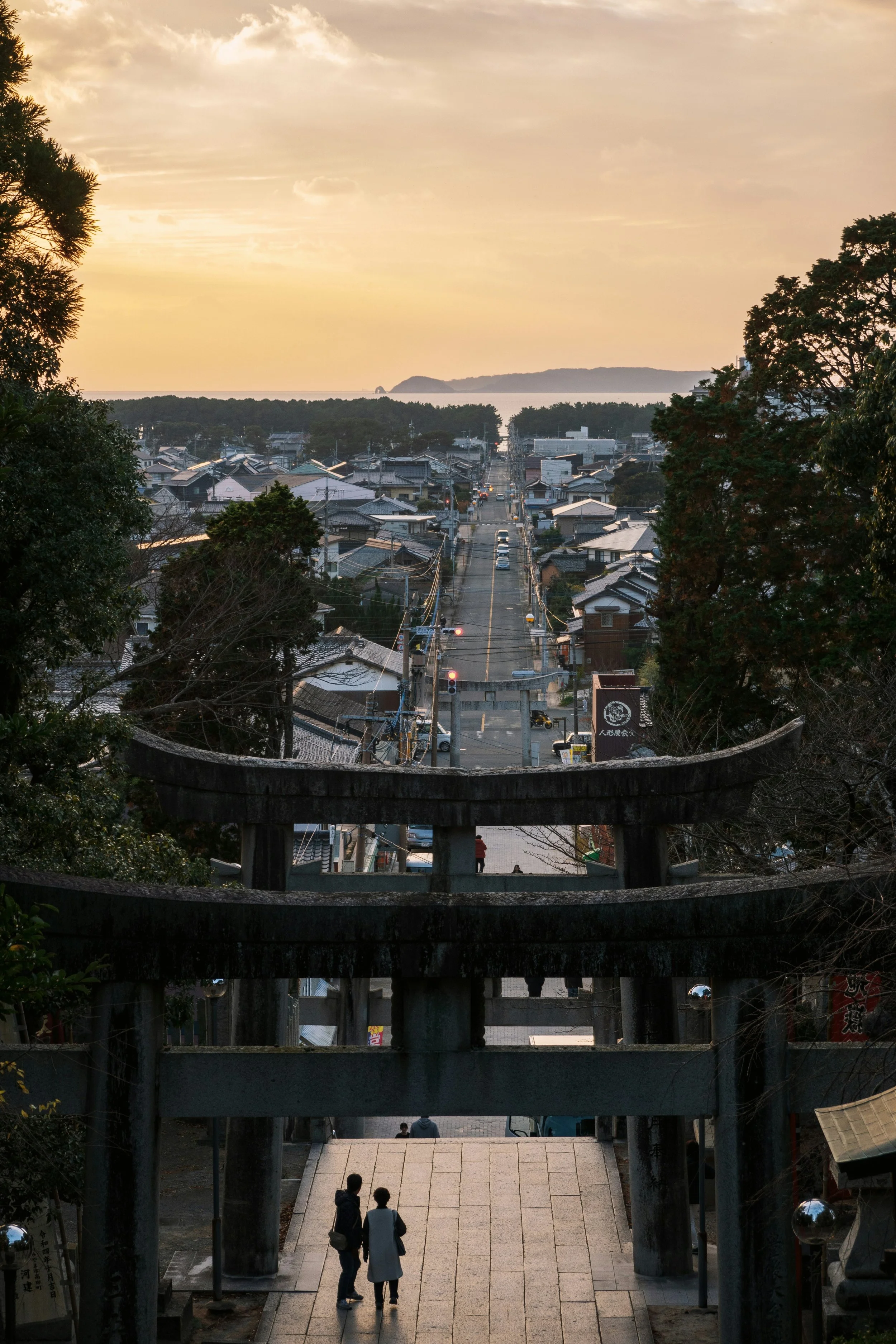
For daytime sightseeing, Ohori Park is the easiest recommendation — a large central pond ringed by a two-kilometer walking path, built on the site of the old Fukuoka Castle moat. It's the kind of unhurried, green space that Japan does exceptionally well. If you have time for a half-day excursion, Dazaifu Tenmangu, one of Japan's most important Shinto shrines, is about 30 minutes outside the city center and worth the trip, especially if your trip happens to coincide with the seasonal blooming of plum or cherry blossoms.
But the real reason to spend a night in Fukuoka is after dark. The city has more open-air food stalls — yatai — than anywhere else in Japan, clustered along the Naka River in Nakasu and around Tenjin. Find one with a few empty stools, strike up a conversation with the chef and whoever's sitting next to you, and order more than you think you'll eat. This is the essential Fukuoka experience, and no amount of daytime sightseeing substitutes for it.
Where to stay in Fukuoka: Daimyo, or the area roughly between Akasaka and Tenjin stations. Central, walkable, and close to both the shopping and the nightlife without putting you in the thick of Hakata Station's crowds. If you’d like specific hotel recommendations, get in touch!
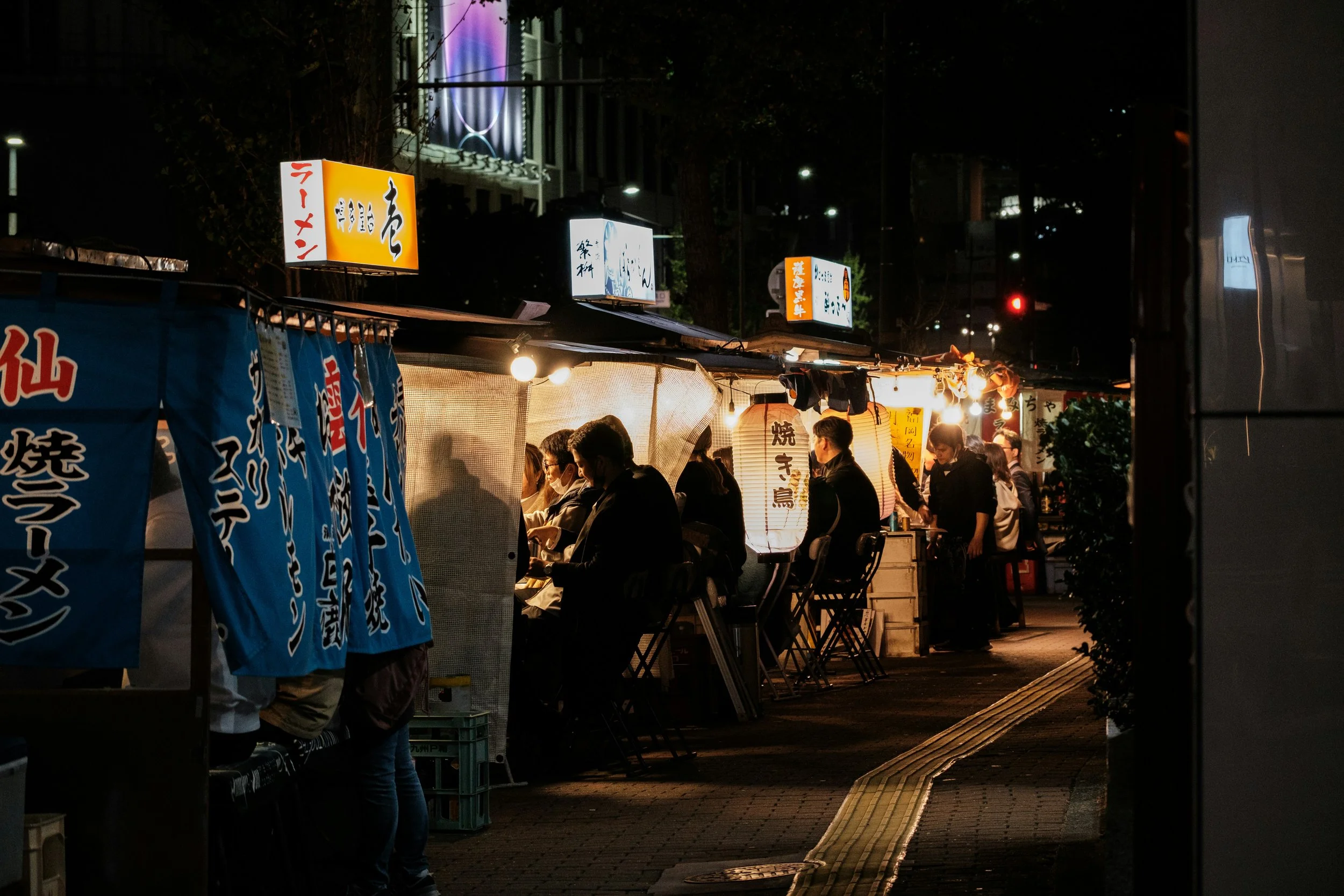
Yatai along the Naka River
Day 2: Fukuoka → Nagasaki (via Shimabara)
Drive time: 3.5 - 4 hours (241 km)
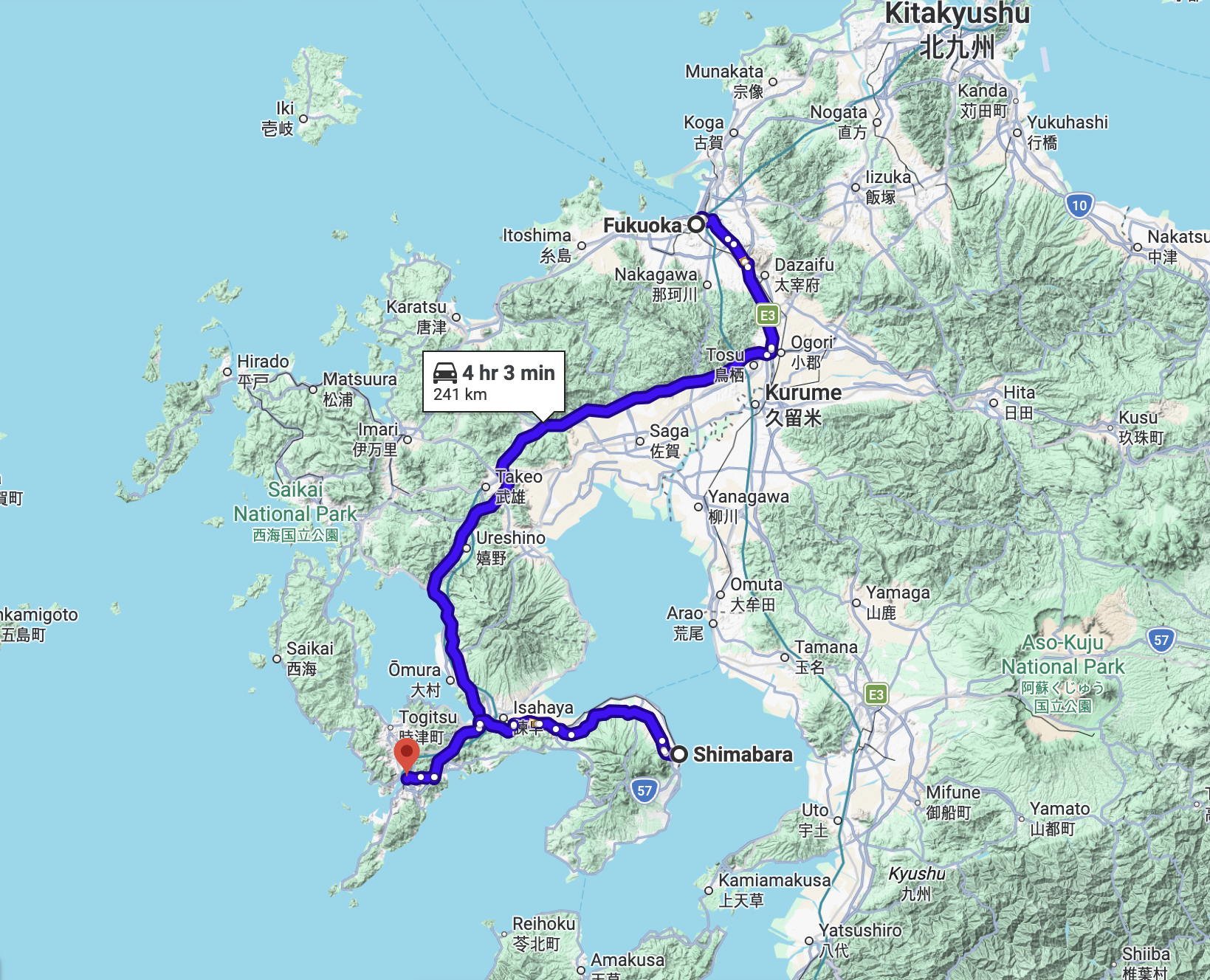
Pick up your rental car this morning and start the loop. This is one of the longer driving days on the trip, so get moving early — especially if you want to properly explore the side quest.
Side quest: Shimabara — allow 2 to 3 hours
Shimabara is a small castle town on the Shimabara Peninsula, and it's worth the detour for two things: the castle itself and the preserved samurai district beside it. Shimabara Castle is a reconstructed five-story keep with a small museum inside (Christian artifacts and armor from the castle's turbulent history — this was ground zero for the Shimabara Rebellion of 1637–38) and an observation deck with views toward Mount Unzen.
A short walk from the castle is a preserved street of lower-ranking samurai residences, three of which are open to the public, free of charge. What makes it special isn't the houses themselves so much as the clear spring water running down a narrow canal through the center of the street — locals call the surrounding neighborhood the "City of Swimming Carp" for the koi that fill these canals. It's a quiet, almost meditative stop, and a nice contrast to the more famous sights ahead.
Budget about an hour for the castle and another hour or so wandering the samurai district before continuing on to Nagasaki. If you're pressed for time, the samurai street alone is worth 30 to 45 minutes even without the castle.
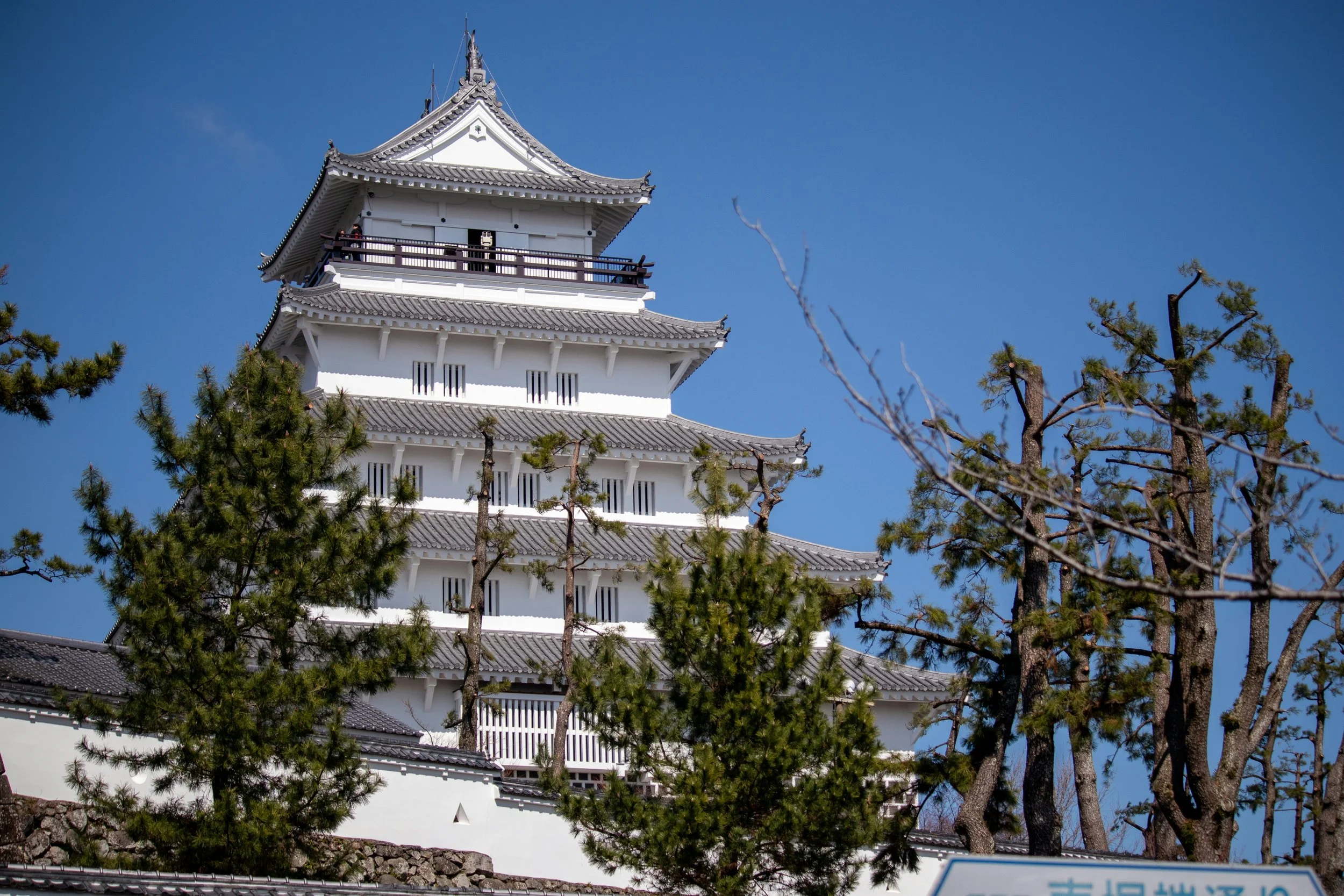
Shimabara Castle
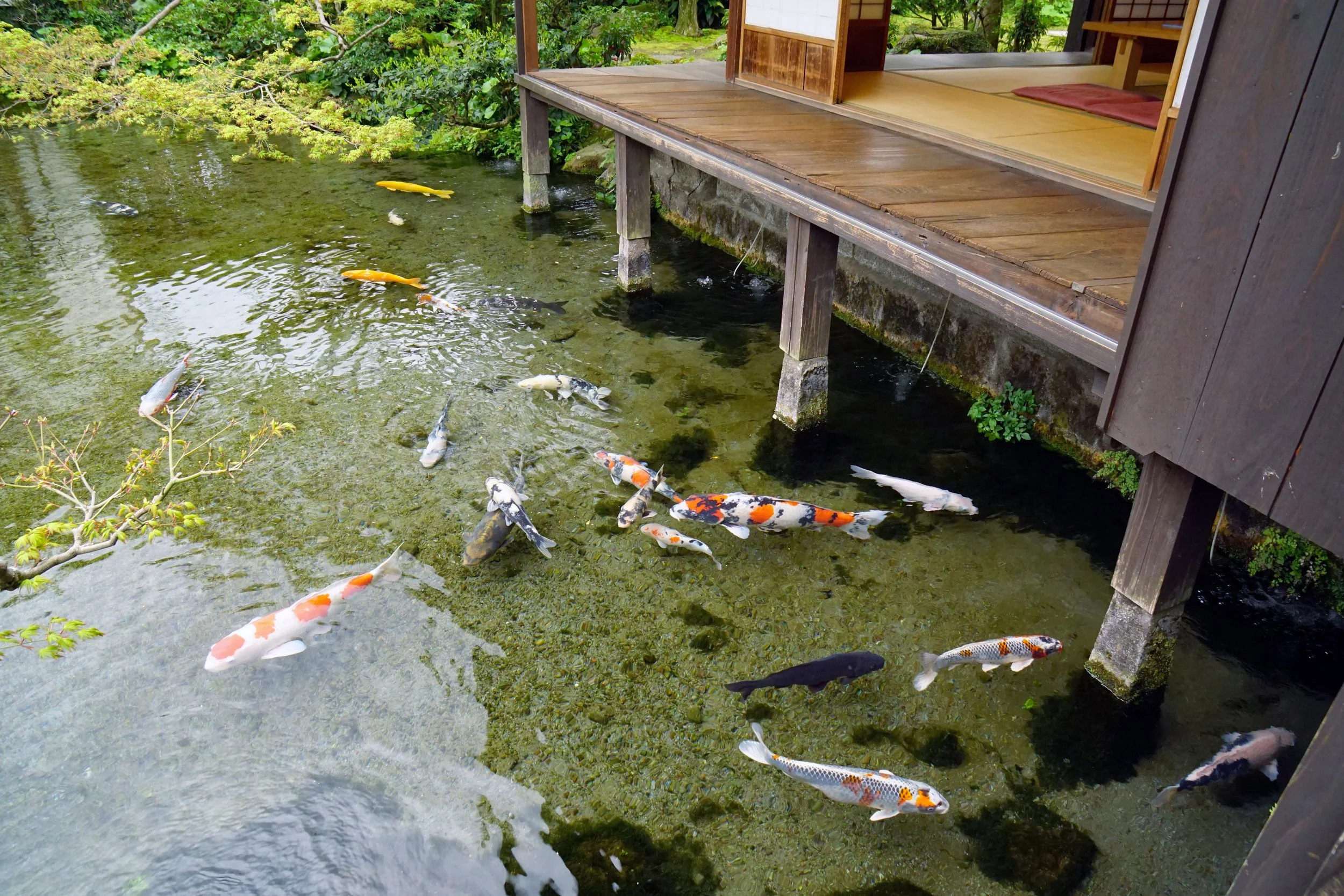
The koi-filled canals of Shimabara’s samurai district
Day 3: Nagasaki
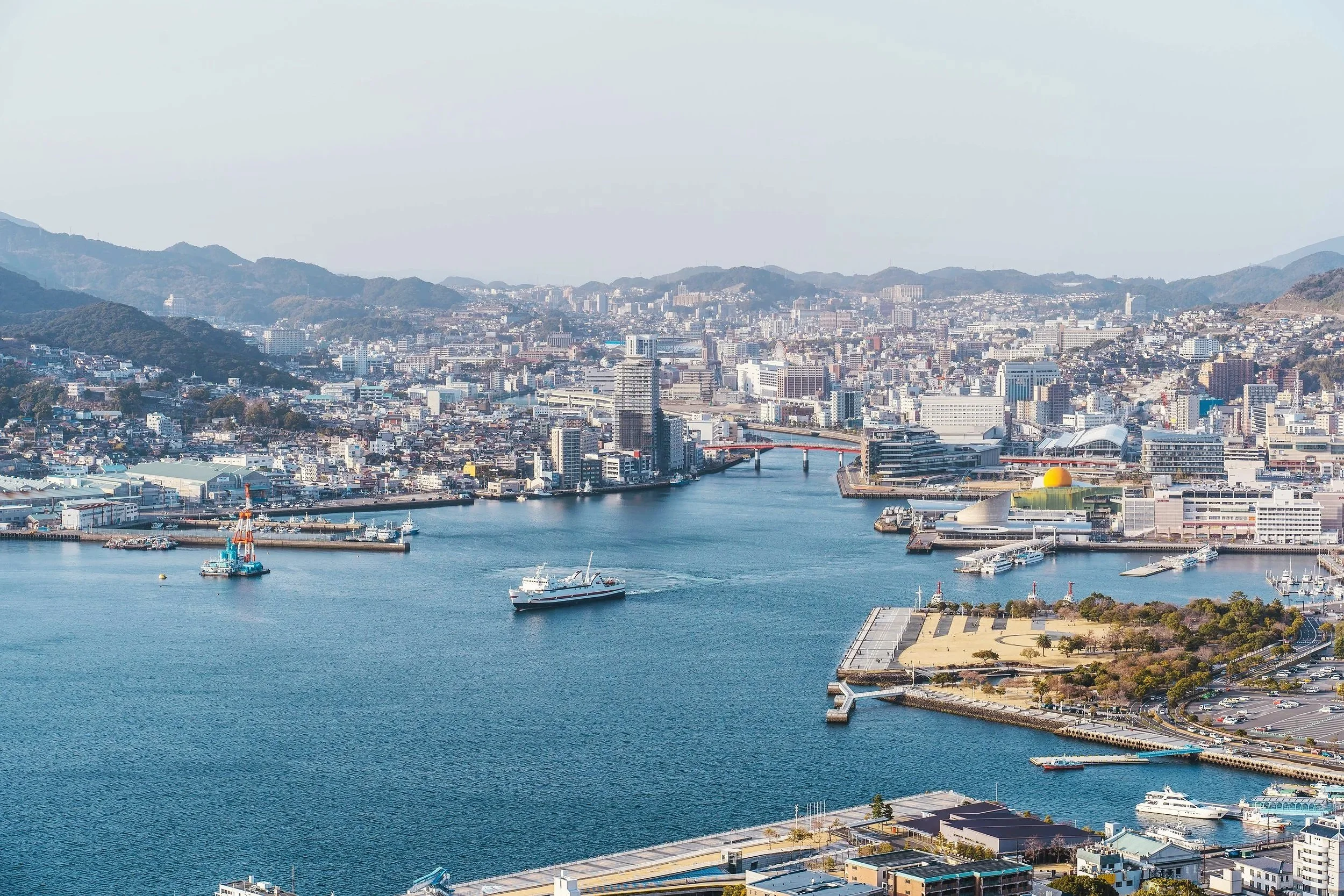
Nagasaki carries some of the heaviest history of any city in Japan, and it's also one of the most physically striking — a city of hills and harbor views that doesn't feel like anywhere else in Kyushu.
If you like museums, the Nagasaki Atomic Bomb Museum and the adjacent Peace Park is excellent. This isn't exactly an easy visit, but it's an essential one — a clear-eyed, well-curated account of the August 9, 1945 bombing and its aftermath. Give yourself at least 90 minutes for the museum alone.
From there, the city's history goes back much further than 1945. Dejima, the small fan-shaped artificial island that was Japan's only point of contact with the outside world during more than two centuries of national isolation, has been reconstructed and is worth an hour of wandering. Glover Garden, an open-air museum of Western-style residences from the Meiji era, sits on a hillside above the harbor and tells the story of the foreign merchants — Thomas Blake Glover chief among them — who helped modernize Japan. Nagasaki's Chinatown, one of the oldest in the country, is the place to try champon and sara udon, two noodle dishes that reflect the city's long history as a meeting point of Chinese, Portuguese, Dutch, and Japanese influences.
If history isn’t really your thing and you’re more interested in seeing some picturesque landscapes, get back in the car and head northwest out of the city to Sotome. Sotome is a rugged, rural coastal area about an hour west of central Nagasaki, known for its dramatic scenery and its history as a stronghold of Japan’s “Hidden Christians.” A scenic drive through the area takes you past small villages, hillside churches, and the Endō Shūsaku Literary Museum, which overlooks the sea and the landscapes that inspired Martin Scorsese's Silence. It’s a worthwhile optional detour if you want to experience a quieter, more atmospheric side of Nagasaki beyond the city’s main sights.
Save the evening for Mount Inasa. The ropeway ride to the summit delivers one of the best night views in Japan — a sweeping, glittering panorama of the city and harbor that's worth planning your day around.
Where to stay in Nagasaki: The Chinatown/Dejima area, or nearby Shianbashi. Central to the tram lines, walkable to the harbor, and close to the ropeway base for your evening trip up Mount Inasa.
Day 4: Nagasaki → Kagoshima (via Ebino Kogen)
Drive time: 5 - 5.5 hours (393 km)
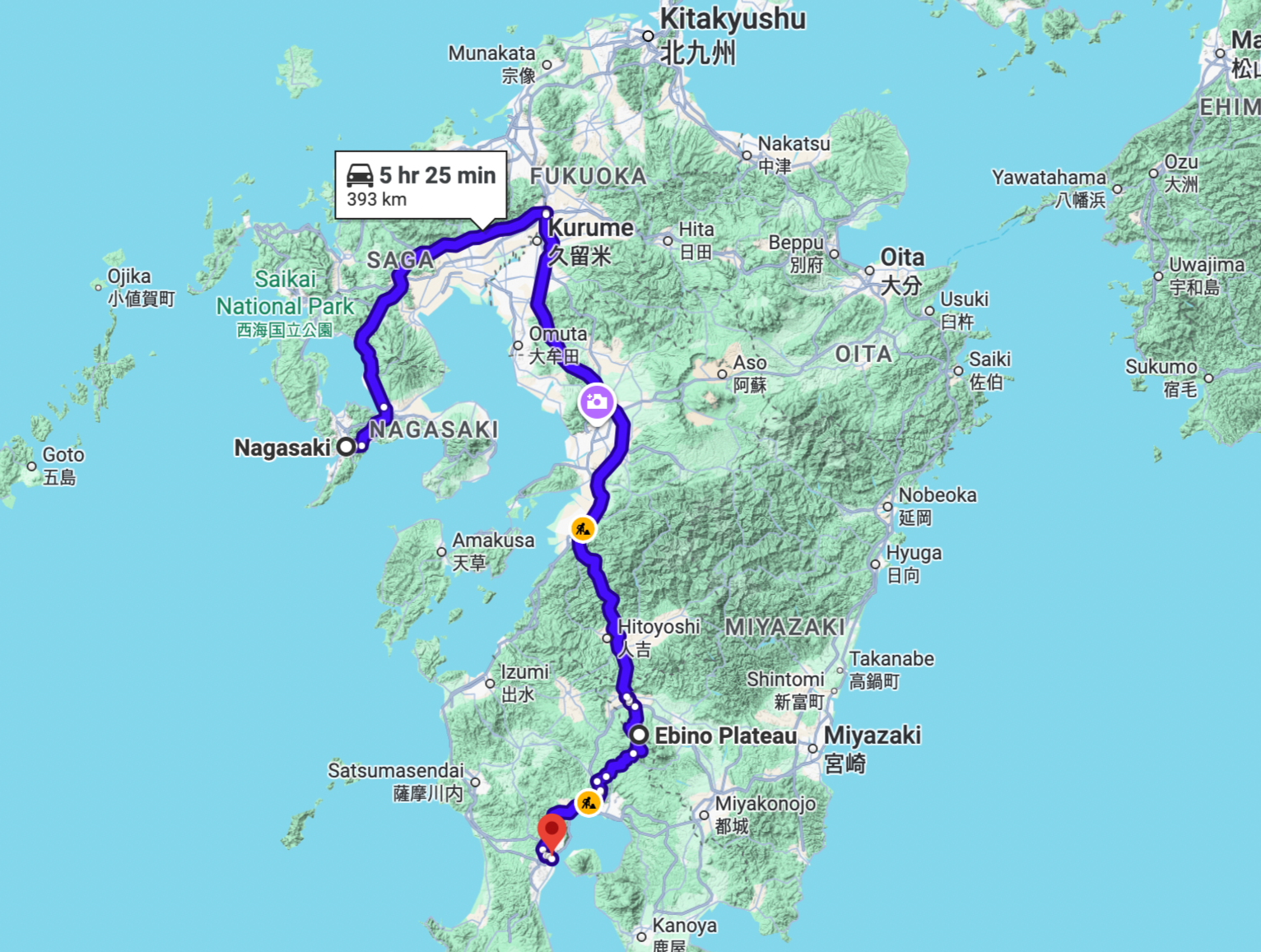
This is the longest driving day of the trip by a wide margin, so start early. The route takes you south through Kumamoto Prefecture and into the highlands before dropping down into Kagoshima.
Side quest: Ebino Kogen — allow 2 to 3 hours
Ebino Kogen is a volcanic plateau sitting at about 1,200 meters in Kirishima-Kinkowan National Park, and it's one of the more overlooked stops on this entire route. The main draw is the Ikemeguri Nature Trail (えびの高原池巡り探勝路), a loop hike of roughly two hours that circles three crater lakes — Byakushi Pond, Rokkannon Pond, and Fudo Pond — through forest and open grassland, with views of the surrounding peaks along the way. The trail is mostly flat with a few gentle climbs, so it's relatively accessible no matter your fitness level.
If you're short on time, even a partial loop out to Byakushi Pond and back is worthwhile, and there's a foot bath and small visitor center at the trailhead if you just want to stretch your legs and grab a coffee. This is high-altitude, geothermal terrain — noticeably cooler than the coast, with sulfur-scarred slopes on Mt. Io — so it's a good contrast to everything else on this trip.
Budget two hours for the full lake loop, or about 45 minutes if you're only doing a partial walk.
Day 5: Kagoshima
Kagoshima is Kyushu's "Naples of the East" — a warm, coastal city that sits directly across the bay from Sakurajima, one of the most active volcanoes in Japan. Sakurajima smokes and occasionally erupts on a near-daily basis, and it dominates the skyline in a way that's hard to overstate until you're actually standing there looking at it.
Take the 15-minute ferry across the bay to the island itself. Once there, you can hike sections of the Nagisa Lava Trail, visit the Sakurajima Visitor Center to learn about the volcano's eruption history, and stop at the free public foot-bath near the ferry terminal — a good spot to sit and watch the volcano smoke while soaking your feet.
Back on the mainland, Sengan-en is a beautifully preserved Edo-period garden and villa that once belonged to the Shimadzu clan, with some of the best views of Sakurajima across the bay you'll find anywhere in the city. It's also a UNESCO World Heritage Site as part of Japan's Meiji Industrial Revolution sites.
Another option is a short trip out to Ibusuki, about 50 minutes south of the city, for a natural sand bath — you're buried up to the neck in volcanic sand heated by geothermal steam, which sounds strange and is genuinely one of the more relaxing things you can do on this trip. For dinner, don't leave Kagoshima without trying kurobuta, the region's famous black pork, whether as tonkatsu, shabu-shabu, or grilled yakibuta.
Where to stay in Kagoshima: Tenmonkan, the city's main downtown arcade. It puts you within walking distance of the Sakurajima ferry terminal, plenty of restaurants and izakaya for the evening, and easy access to the tram if you'd rather not drive within the city itself.
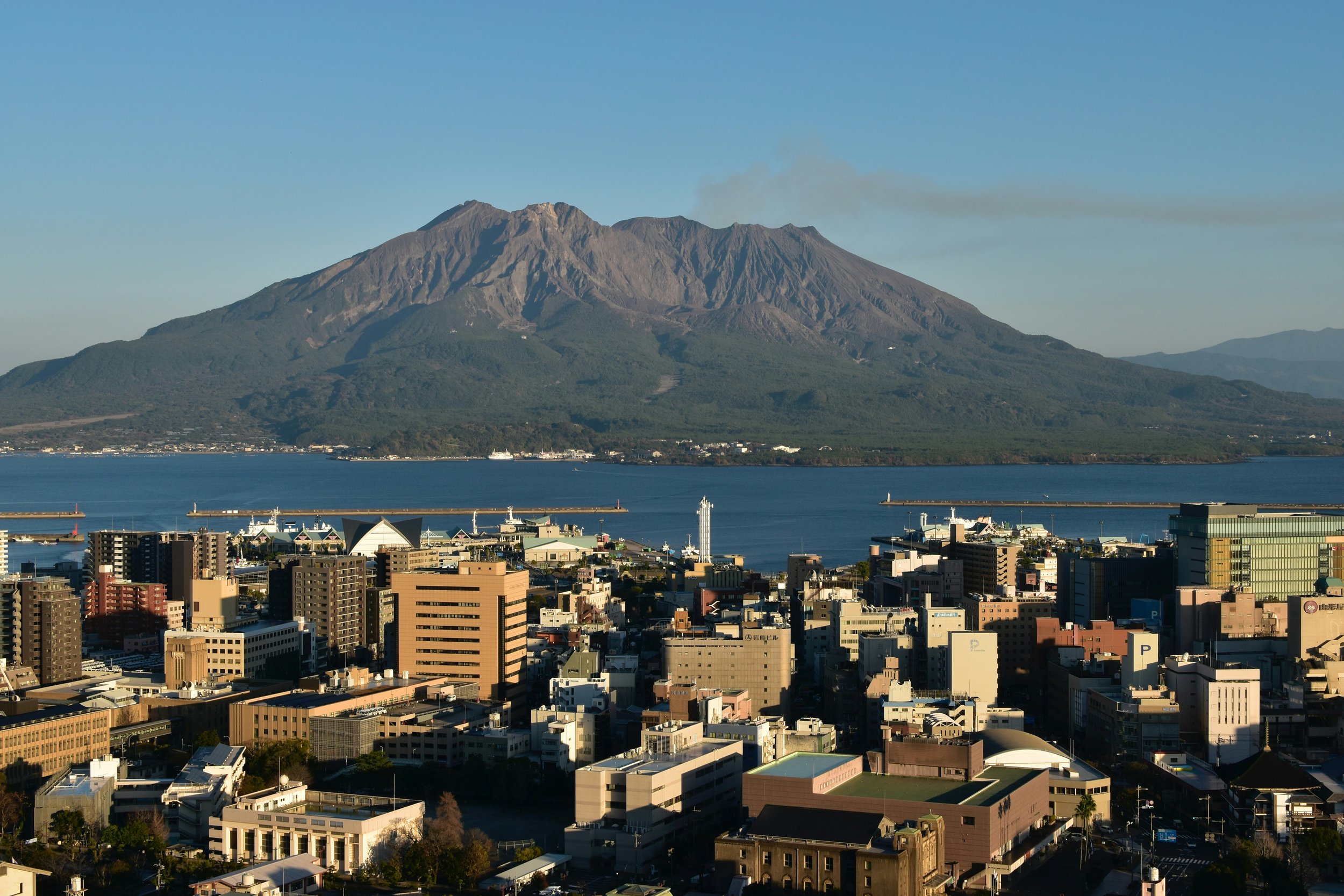
Day 6: Kagoshima → Aso (via Takachiho)
Drive time: 4 - 4.5 hours (281 km)
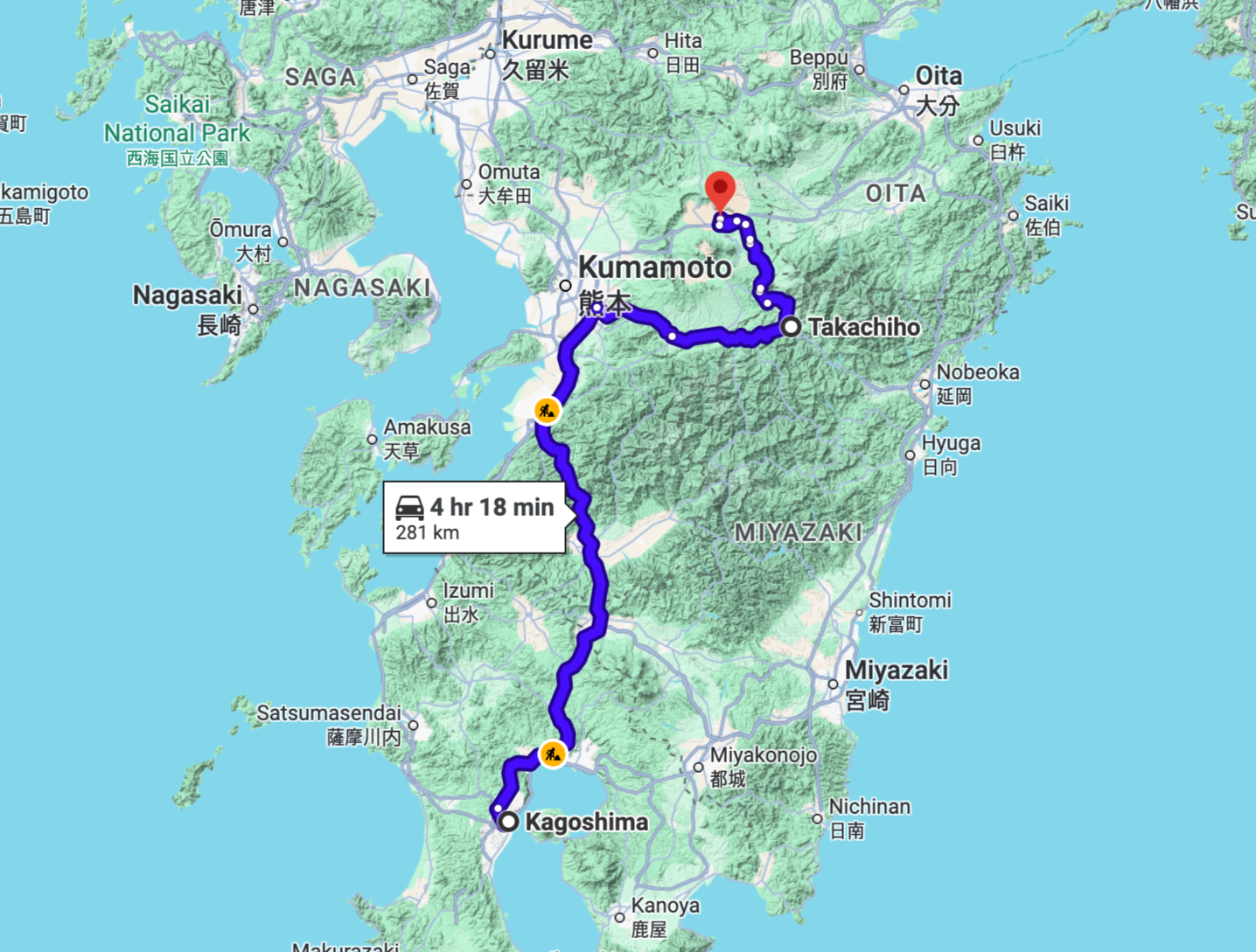
Another long driving day, and possibly the most rewarding side quest of the entire trip is on this route, so plan your timing accordingly and don't rush it.
Side quest: Takachiho — allow 3 to 4 hours
Takachiho occupies a unique place in Japanese mythology. It is said to be the site where the sun goddess Amaterasu's grandson descended from heaven to found the imperial line, and nearby Amano Iwato Shrine marks the cave where Amaterasu herself is said to have hidden after a quarrel with her brother, plunging the world into darkness. Whatever your relationship to the mythology, the physical setting lives up to the reputation.
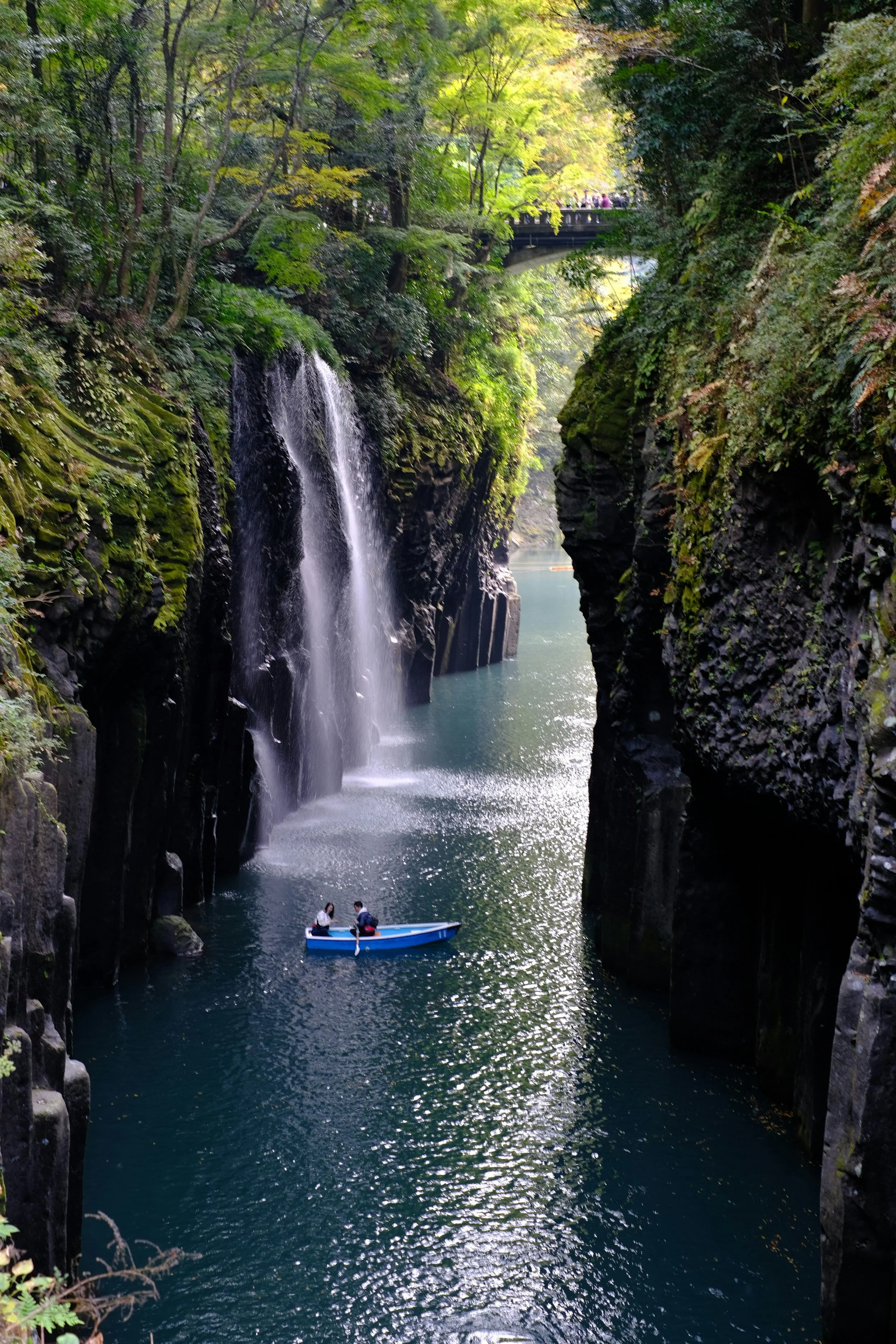
Takachiho Gorge is the main event: a narrow, sheer-walled ravine carved by the Gokase River, with the 17-meter Manai Falls as its centerpiece. Rent a rowboat and paddle beneath the cliffs and past the waterfall — this is the single best way to experience the gorge, though the boats are popular and can sell out, especially on weekends, so try to arrive early. If the boats are full or you'd rather stay dry, there's also a walking path along the rim with excellent views down into the ravine.
If your timing allows, visit Takachiho Shrine in the evening. Every night from 8 to 9pm, the shrine hosts a Kagura performance — a traditional sacred dance depicting the Amaterasu myth — for a small entrance fee. It's a special way to end the day, though it will push your arrival in Aso later into the evening.
Budget 90 minutes to two hours for the gorge (more if you're boating and there's a queue), plus another hour if you're adding the shrine and Kagura performance.
Day 7: Aso
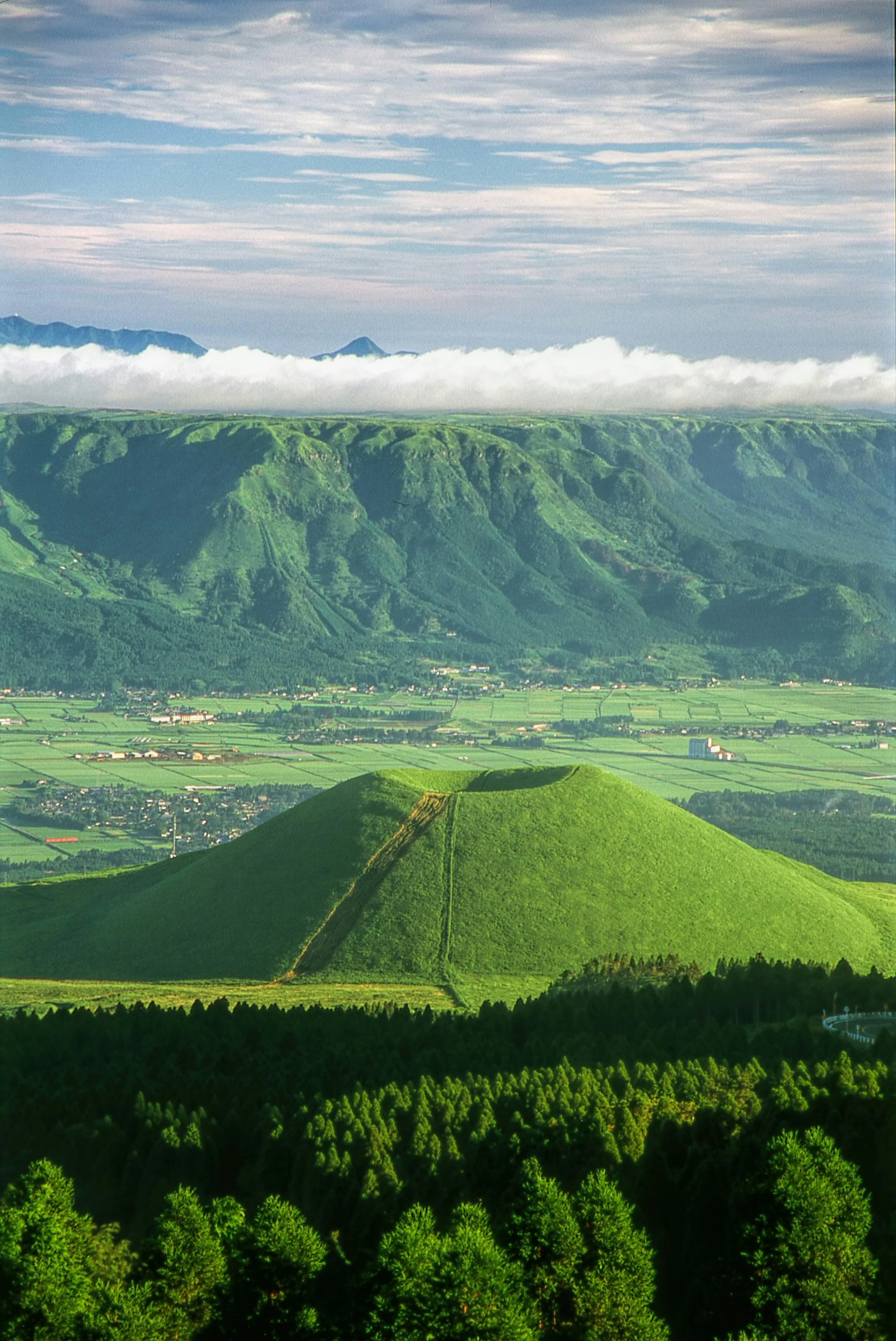
Aso is home to one of the largest calderas in the world — a volcanic basin roughly 25 kilometers across, still active, with five peaks rising from its floor. It's a landscape unlike anything else on this trip: vast, green, and almost otherworldly.
Start at Daikanbo, a lookout point widely considered the best vantage over the entire caldera. From here you can see the central volcanic cone group, the surrounding grasslands, and the far caldera walls all at once — on clear autumn mornings, a cloud inversion sometimes fills the basin with a "sea of clouds" below the rim.
From there, head to Kusasenri, a broad grassy plain inside an older, dormant crater, where horses and cattle graze against a backdrop of smoking Mt. Nakadake. There's a small museum with a live camera feed of the active crater lake, plus a café that's a good spot for a break.
If conditions allow — the ropeway and access road are frequently closed due to volcanic gas, so check ahead — the Nakadake crater itself is worth the trip up. Standing at the rim and looking down into an actively steaming, brilliantly turquoise crater lake is not something you get to do in many places. Even when it's closed, though, Kusasenri and Daikanbo alone make for a full and worthwhile day.
Where to stay in Aso: Aso isn't really a single town so much as a scattering of villages across the caldera, so aim for Uchinomaki Onsen — the closest thing to a walkable center, with its own small hot springs, restaurants, and easy access to both Daikanbo and Kusasenri.
Day 8: Aso → Beppu (via Kurokawa Onsen)
Drive time: 1.5 - 2 hours (101 km)
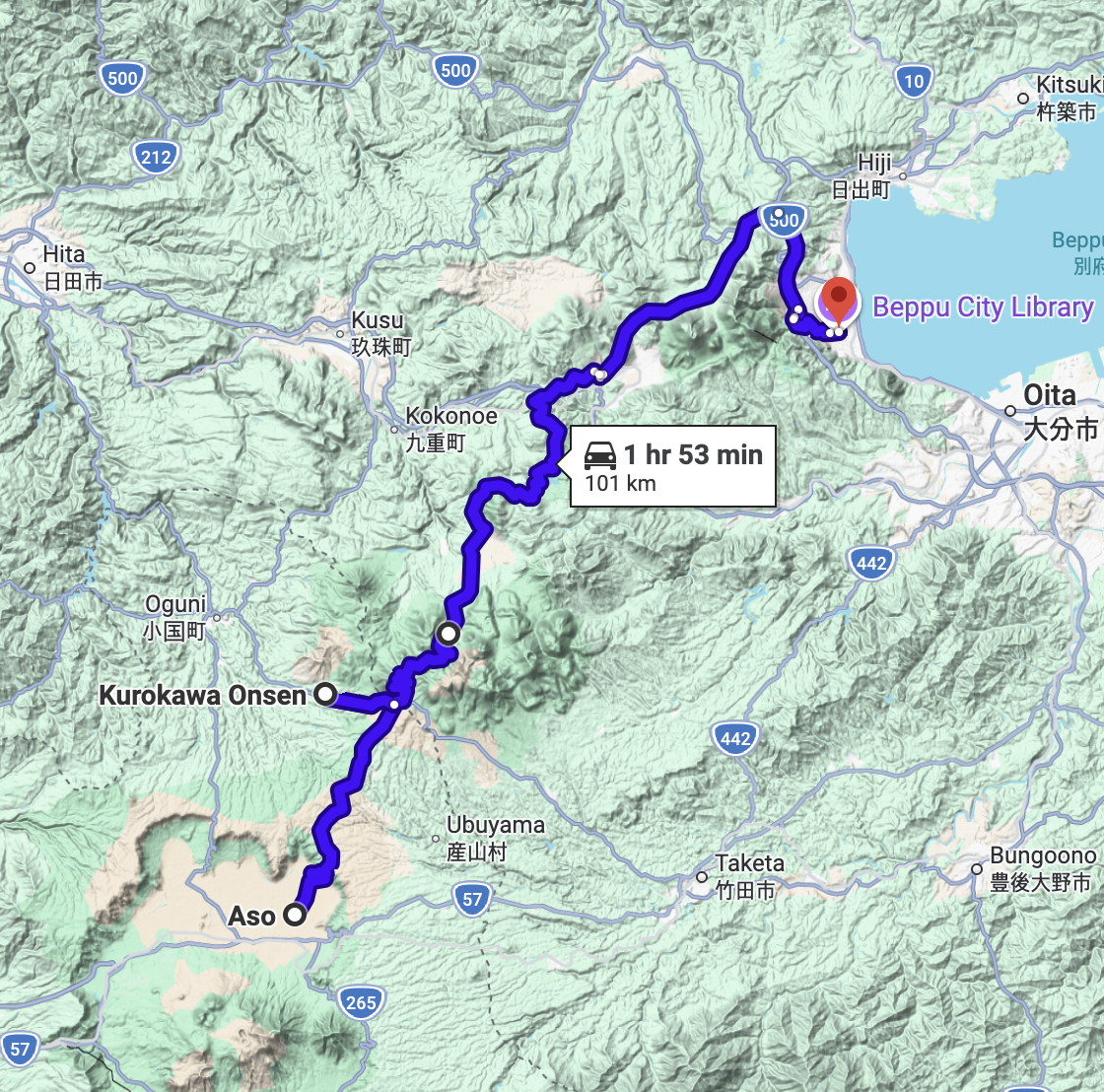
The shortest driving day of the trip, which makes it the easiest one to build a leisurely half-day stop into. The route follows the scenic Yamanami Highway through the mountains between Aso and Beppu.
Side quest: Kurokawa Onsen — allow 2 to 4 hours
Kurokawa is widely considered one of the most beautiful hot spring villages in Japan, tucked into a narrow, forested river valley with no large modern hotels, no neon, and no convenience stores — the local hotel association has been deliberate about preserving that atmosphere for decades. Roughly two dozen ryokan line the river, each with its own distinctive outdoor bath (rotenburo), carved into rock faces, tucked into bamboo groves, or perched over the rushing water below.
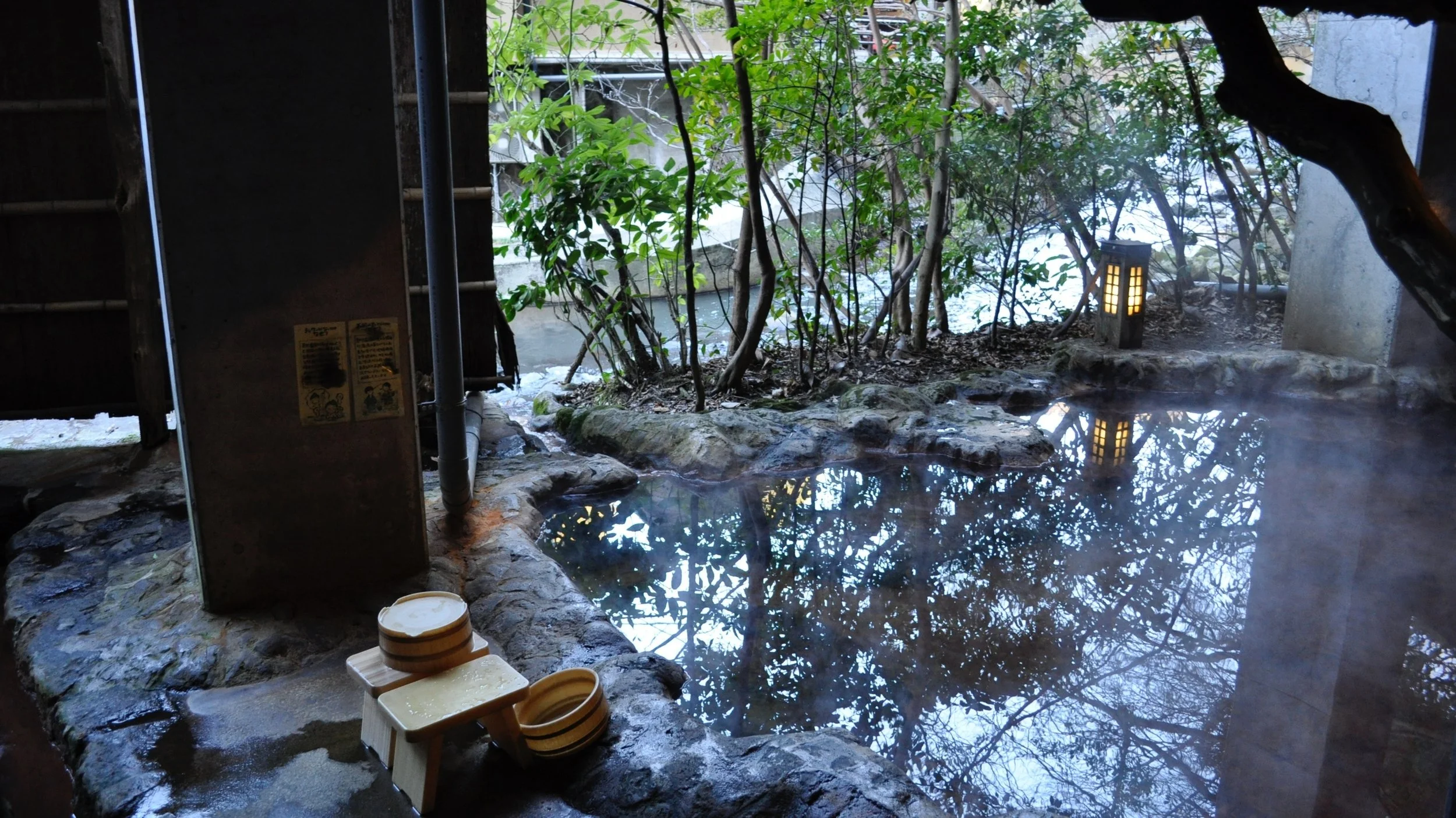
The thing to do here is rotemburo meguri — onsen hopping. Buy a nyuto tegata, a wooden bathing pass sold at the village's tourism office, for about 1,500 yen. It gets you into any three of the participating ryokan's outdoor baths, valid for six months if you don't manage to use all three slots in one visit. Given that you're mid-road-trip and possibly a little stiff from days of driving, this is exactly the kind of stop that resets you for the rest of the day.
Give yourself at least two hours if you're doing two baths with time to walk between them, longer if you want to linger, eat lunch in the village, or explore all three. Note that bathing here is done nude and gender-separated (unless you've booked a private bath), so come prepared for that if it's your first time.
Day 9: Beppu
Beppu is Japan's onsen capital in the most literal sense. Over 2,000 hot spring sources feed a city that produces more geothermal water than anywhere in the world except for Yellowstone in the US . You'll smell the sulfur before you see the steam rising from vents around the city.
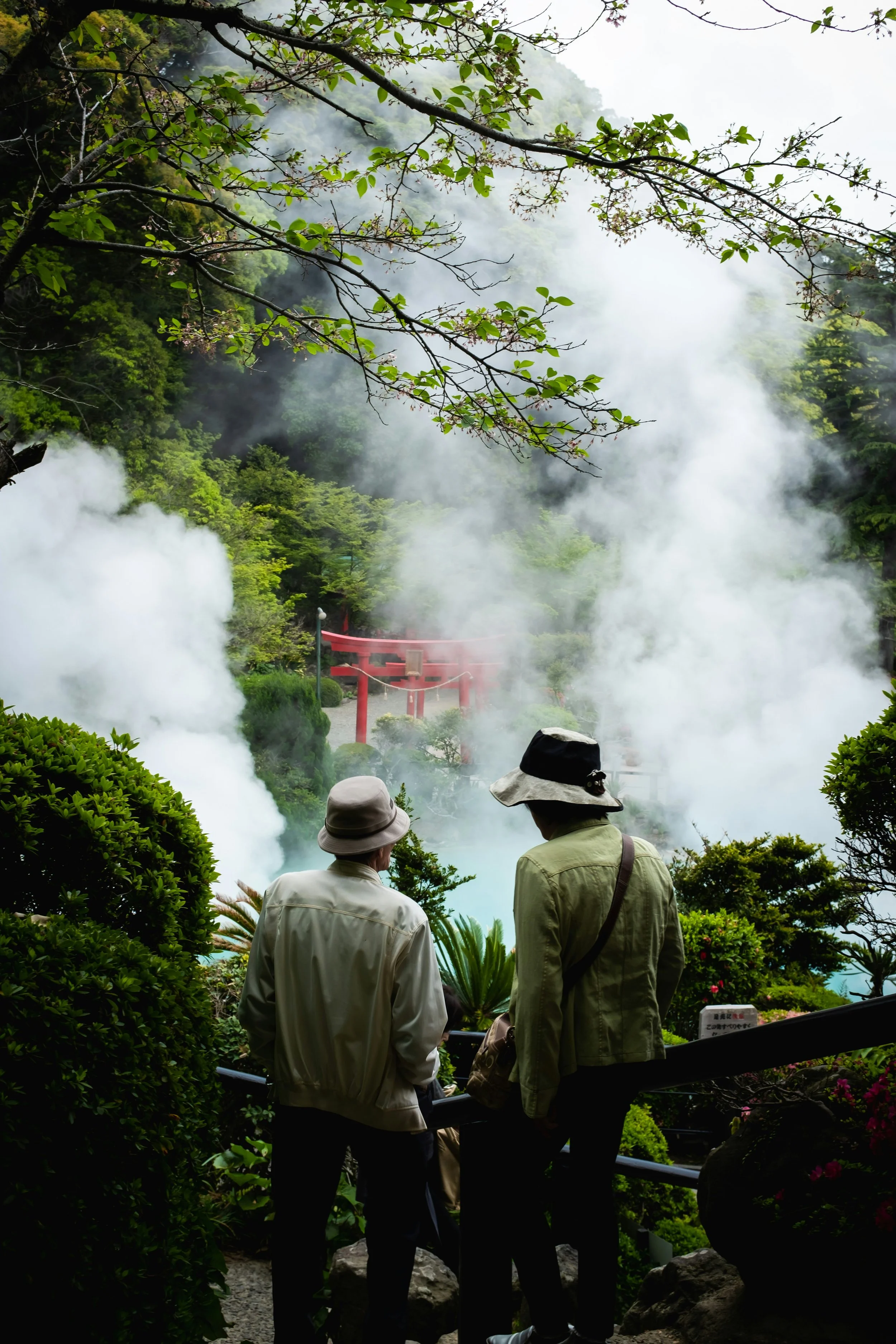
The signature activity here is the Jigoku Meguri, or "Hell Tour" — a circuit of seven dramatically colored hot spring ponds, each one for viewing rather than bathing, since most run close to boiling. Umi Jigoku is a striking cobalt blue, Chinoike Jigoku runs blood red from iron oxide in the water, and Oniyama Jigoku, somewhat bizarrely, keeps a population of crocodiles warmed by the spring water. The hells are spread across two clusters — Kannawa and Kamegawa — and are connected by local buses if you're not driving between them directly. Budget half a day if you want to see most of them, and don't skip the jigokumushi purin, a custard pudding steamed using the same geothermal heat.
For the bathing half of your day, Beppu's Takegawara Onsen is one of the oldest in the city and offers a traditional sand bath experience — you're wrapped in a yukata and buried up to the neck in hot, steam-warmed sand rather than water. It's similar to the experience at the Ibusuki's beach sand baths I mentioned back in the Kagoshima section, but without the ocean views. If you'd rather have a proper soak, Hyotan Onsen is a well-regarded facility with both indoor and outdoor baths in a garden setting.
If you have energy left in the evening, the Beppu Ropeway climbs Mount Tsurumi for panoramic views over Beppu Bay — a nice way to close out your last full day on the road.
Where to stay in Beppu: If you haven’t already done so by this point in your trip, I highly recommend staying at a traditional ryokan during your time in Beppu. A ryokan is a traditional Japanese inn, and staying in one is a different experience from a hotel stay — the room usually comes with tatami mat flooring, sometimes with a futon laid out on the floor rather than a bed, and a yukata for lounging around the property. Many, especially here in an onsen town like Beppu, include their own private or semi-private hot spring bath as part of the stay, and the better ones fold in a kaiseki dinner — a multi-course, seasonally driven meal served in your room or a private dining area. It's less a place to sleep and more a slower, more immersive way to experience Japanese hospitality, and Beppu is the perfect place to try it if you haven't before. There are plenty of ryokan to choose from in the area, but I can personally recommend Matsubaya. I stayed there with my wife last time we were in Beppu, and we still sometimes reminisce about how lovely it was.
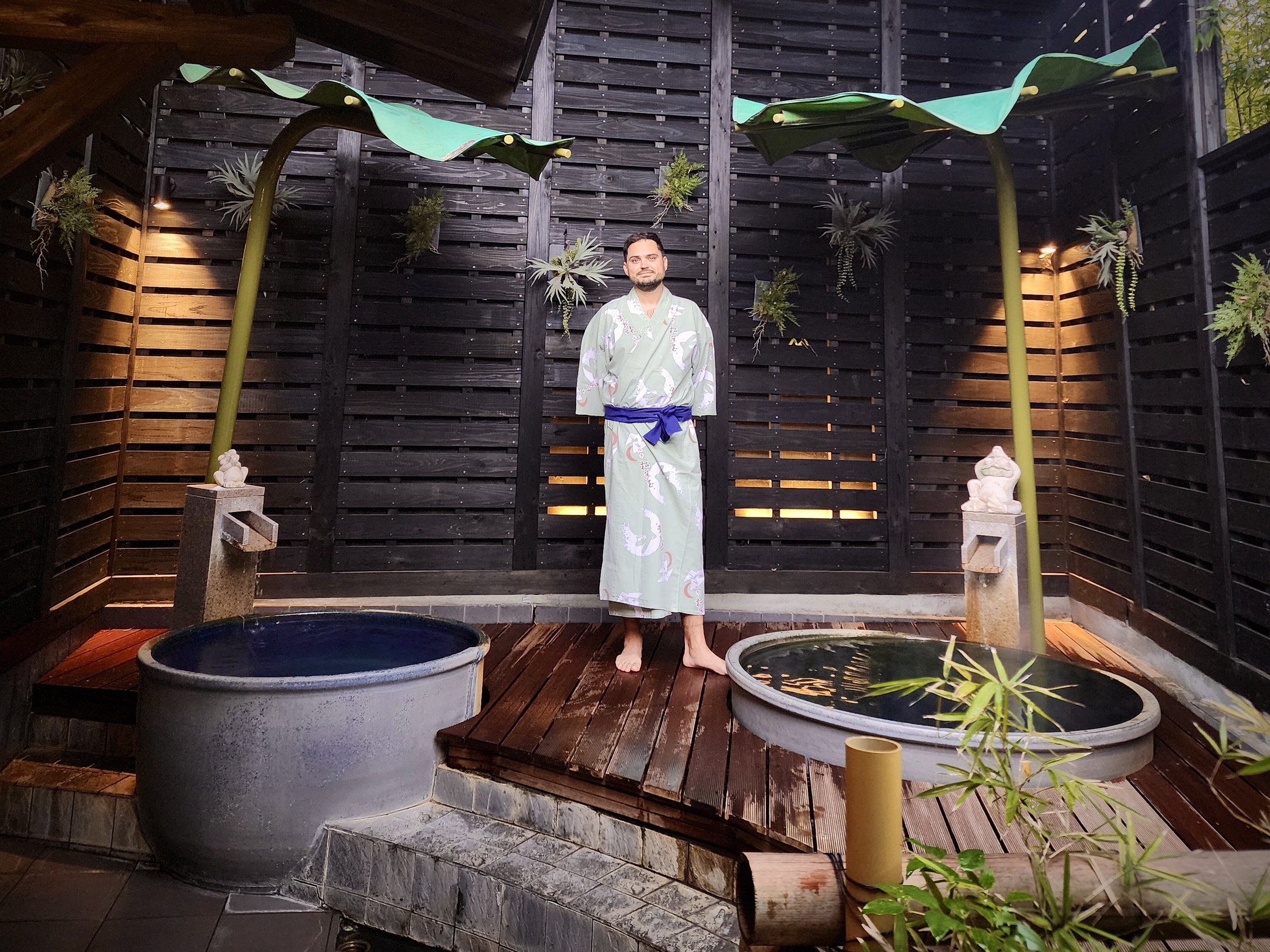
Images of my wife and I in one of the private onsen baths at Matsubaya Ryokan.
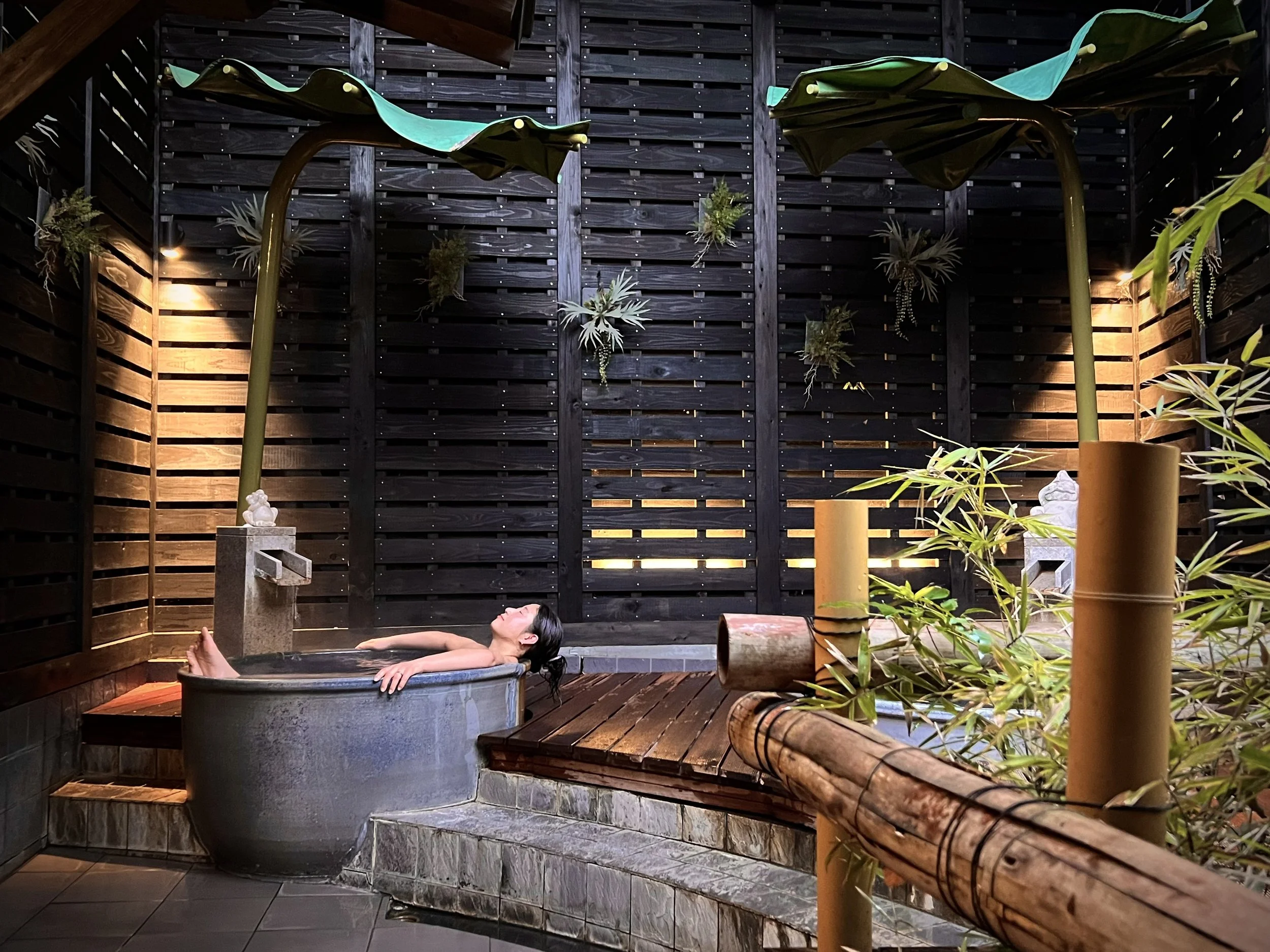
If you’re not into the idea of public bathing, a ryokan with private baths is a great way to experience this part of Japanese culture without discomfort.
Day 10: Beppu → Fukuoka (via Yufuin)
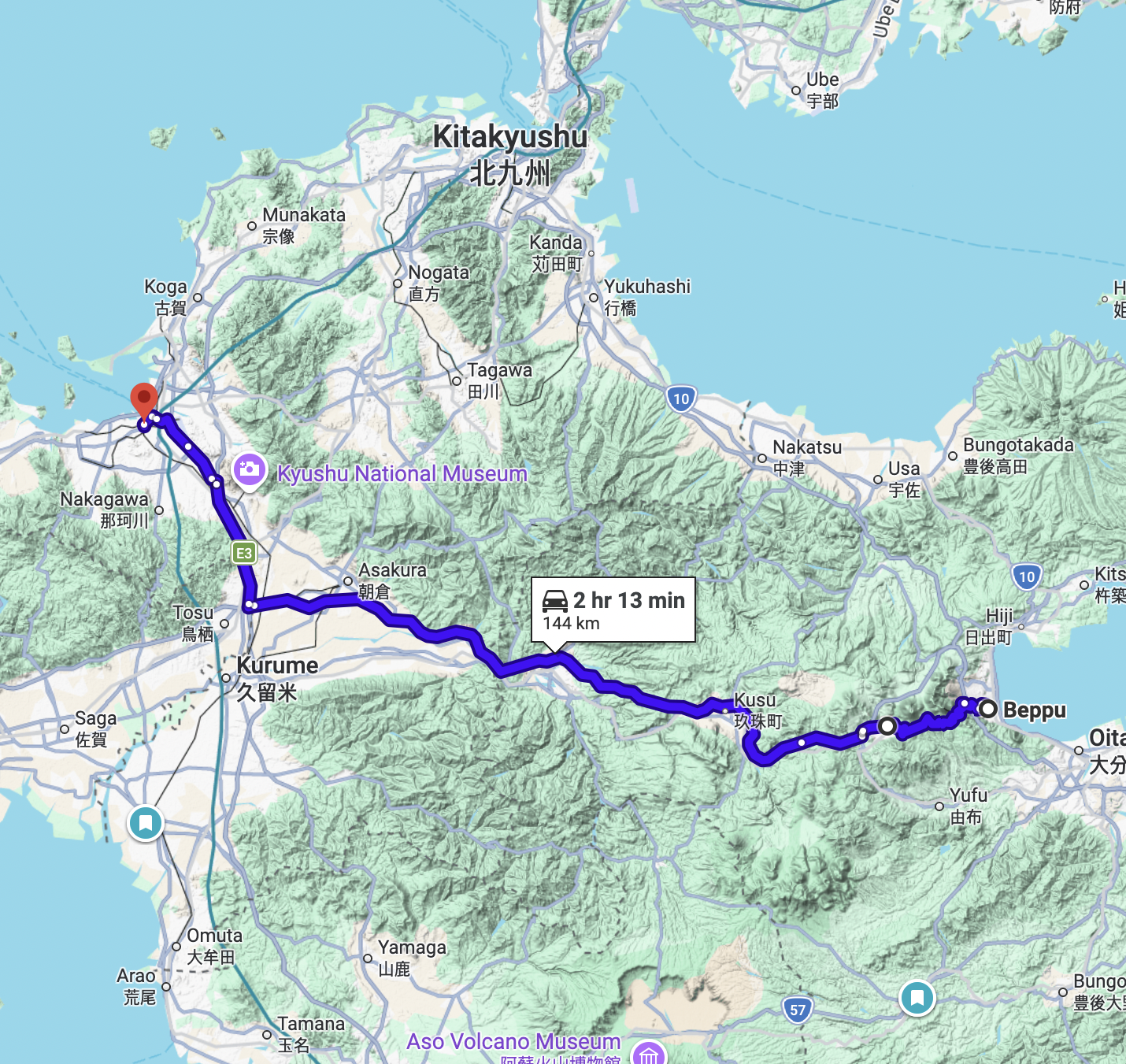
Drive time: 2 - 2.5 hours (154 km)
The final leg, and a short, easy drive back to where you started.
A note about the driving route: It only takes about 35 minutes to drive from Beppu to Yufuin, and there are two routes — one takes you on a major highway (616) north of Mt. Yufu, while the other takes you on a much more scenic road (11) south of Mt. Yufu. The driving time is essentially the same either way, so take the scenic route. This is your last day of driving in Kyushu, so you may as well enjoy it while you still can.
Side quest: Yufuin — allow 2 to 3 hours
Yufuin sits in a valley at the base of Mount Yufu — sometimes called the "Mount Fuji of Oita" for its distinctive peak — and it's a gentler, more boutique-driven onsen town than Beppu, popular with domestic travelers for a weekend getaway.
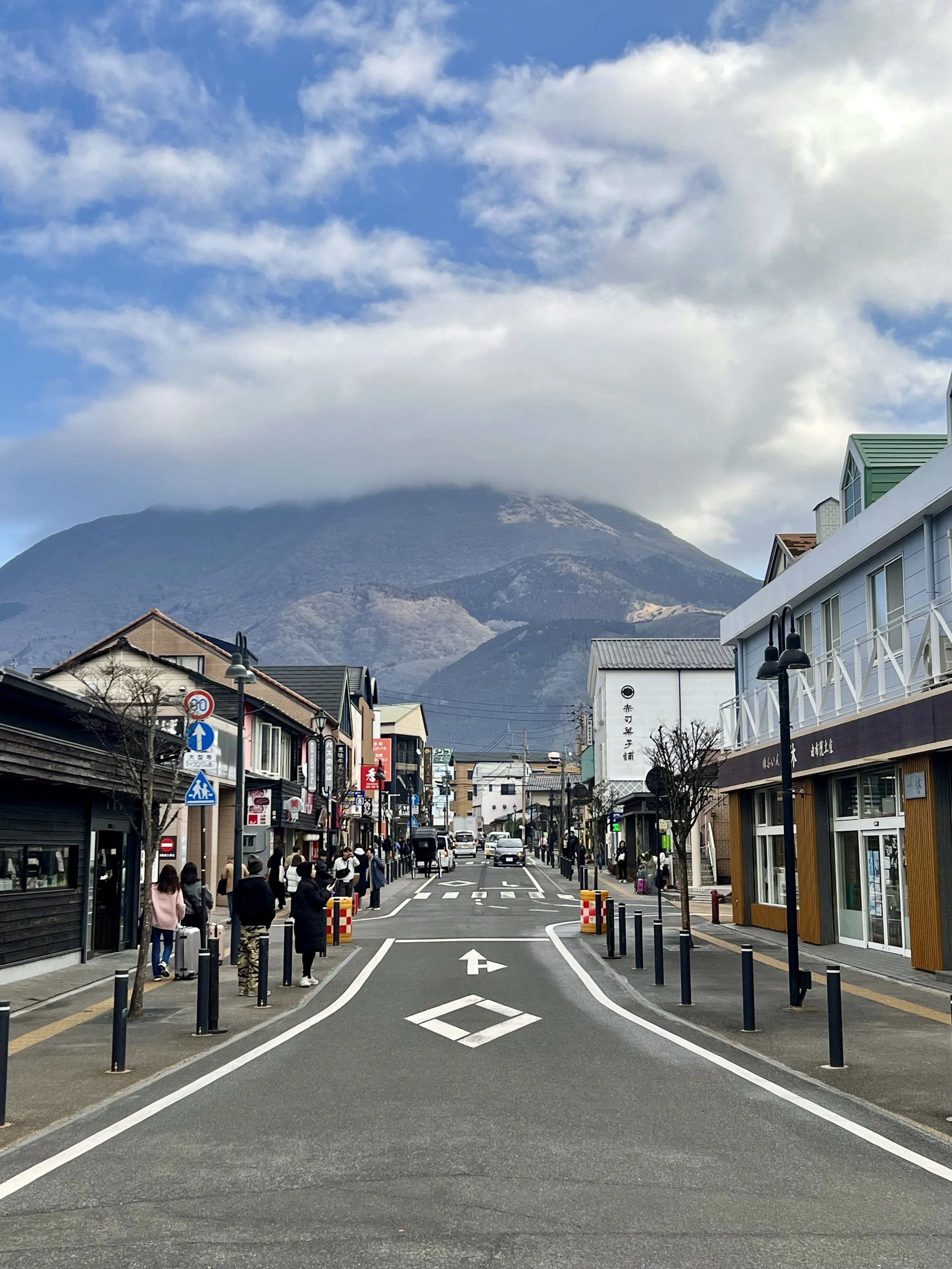
Mt. Yufu looms over Yufuin’s main shopping street
On the edge of town sits Lake Kinrin — small and quiet, known for the mist that rises off its surface on cool mornings. It's an easy, scenic walk around the perimeter, with a handful of cafes worth a stop if you have time. From there, Yunotsubo Kaido, the main shopping street connecting the lake to the train station, is lined with craft shops, small museums, and sweets stalls — this is the place to pick up the region's famous Yufu cheesecake or try some astoundingly good matcha gelato at Telato. Yufuin Floral Village, a small, whimsical shopping area modeled loosely on the English Cotswolds, is a bit of a tourist-trap curiosity but a fun 20-minute detour if you have kids in tow or just want the photos.
This is meant to be a lighter, half-day stop rather than a full destination — a good decompression point before you return the rental car and close out the loop back in Fukuoka.
Variations of the Itinerary:
If you have an early flight out on Day 10, you can make things easier on yourself by staying just one night in Beppu (Day 8), skipping the Hells tour and just enjoy the onsen/ryokan culture. Then, return to Fukuoka via Yufuin on Day 9.
If you have some more time and want to extend this into a two-week trip, add two nights in Miyazaki to the middle of the itinerary between Kagoshima and Aso, along with an extra night at two of the other destinations featured here. Miyazaki is a notable omission from this itinerary. It’s absolutely worth visiting, but it doesn’t fit easily into this 10-day plan.
Things to Know Before You Go
Renting a car: You'll need an International Driving Permit — check this before you leave home, as not every country's permit qualifies (French, German, Swiss, and a few other nationalities need an official Japanese translation of their license instead, available through JAF or your embassy). Book your rental in advance, especially in peak seasons, and consider requesting an ETC card for the toll roads — it lets you pass through toll gates without stopping and settle the total when you return the car, which is far less hassle than paying cash at every gate.
Driving in Japan: I know some people might be intimidated by the idea of driving in a foreign country, but Japan is one of the easier places in which to do it. The Japanese are a famously polite and orderly people, and that stereotype extends to their driving culture. Traffic drives on the left, and the expressway network connecting these cities is excellent — well-maintained, well-signed, and genuinely enjoyable to drive, especially on stretches like the Yamanami Highway between Aso and Beppu. Local roads through mountain passes are slower and more winding but often more scenic. Rather than a street address, Japanese GPS units typically want a phone number or a "Mapcode" — keep these handy for your hotels and key stops.
The side quests in this itinerary are optional but highly recommended. Every one of them adds real value to this trip, but they do add time — get an early start on driving days so you're not rushing through Shimabara, Ebino Kogen, Takachiho, Kurokawa, or Yufuin to make it to your next hotel before dark.
When to go: Spring (April–May) and fall (October–November) are the sweet spots for this route — mild temperatures for hiking and driving, plus cherry blossoms or fall color depending on timing. Summer in Kyushu is hot, humid, and prone to typhoons; winter is manageable on the coast but expect the mountain passes around Aso and Ebino Kogen to be colder and occasionally affected by snow.
